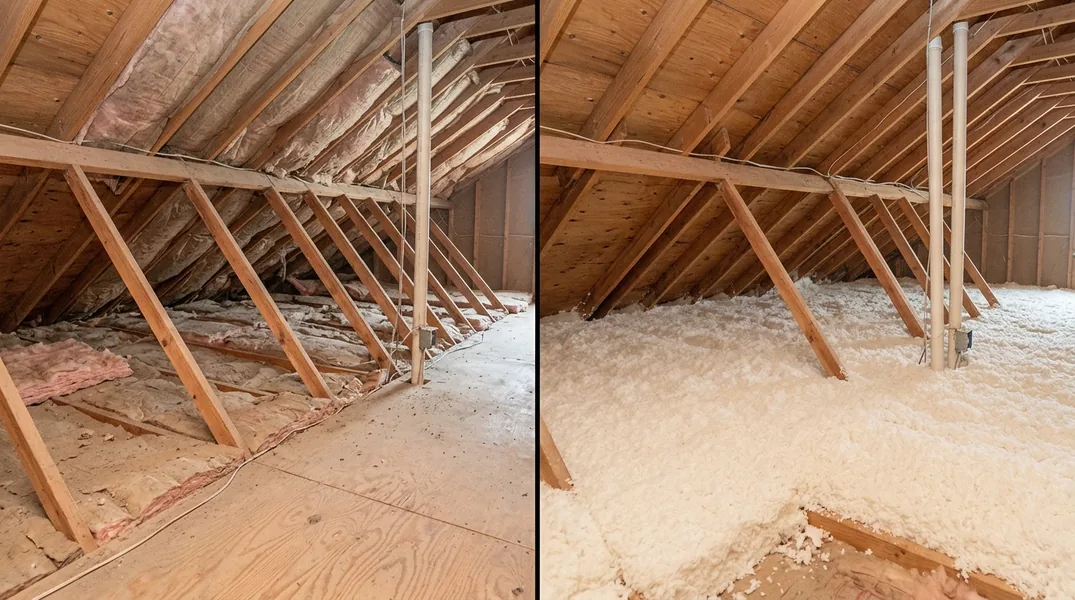
The Settlement Problem: Why Blown-In Insulation Fails Ranch Homes
East Peoria's classic ranch homes were built with charm and simplicity, but many were insulated with materials that simply don't age well. Over the past 30 to 50 years, countless homeowners have discovered that their attic insulation has settled, compacted, or deteriorated, leaving significant gaps in thermal protection. This isn't a manufacturing defect or a sign of poor installation. It's a fundamental limitation of how certain insulation materials behave over time.
Blown-in insulation, whether fiberglass or cellulose, relies on loose fibers to trap air and create an insulating barrier. As your home experiences seasonal temperature swings, vibrations from wind, and the natural settling of the structure itself, these fibers gradually compress and shift. In Peoria's climate, where winters demand consistent heating and summers require cooling, this constant thermal cycling accelerates the breakdown process. What started as a full 12 inches of insulation in 1975 may now be just 6 or 7 inches in critical areas, drastically reducing your home's R-value and forcing your HVAC system to work harder.
Spray Foam vs Blown In Insulation: The Durability Difference
When comparing Attic Spray Foam Insulation to traditional blown-in materials, the longevity advantage becomes immediately clear. Spray foam is applied as a liquid that expands and hardens in place, creating a solid, monolithic barrier that doesn't settle, compress, or shift over time. Once cured, spray foam maintains its R-value for the life of your home. There's no gradual loss of effectiveness, no need for periodic top-ups, and no surprises when you have your attic inspected decades later.
Blown-in insulation, by contrast, continues to settle throughout its lifespan. Cellulose fibers are particularly prone to this issue, especially in humid climates where moisture absorption can speed up the settling process. Fiberglass batts and loose-fill also compact under their own weight and due to air movement within the attic space. The physics is unavoidable: lightweight fibers will eventually shift and consolidate. For homeowners in East Peoria looking for a permanent solution, this difference is critical.
Spray Foam vs Fiberglass: Why Your Neighbors' Old Insulation Isn't Protecting Them Anymore
Fiberglass has been the standard for residential attic insulation for decades, and for good reason. It's affordable, relatively easy to install, and provides decent initial R-value. However, fiberglass batts and blown-in fiberglass share a common weakness: they offer virtually no air sealing. Your attic insulation is only as effective as the air barrier it creates, and fiberglass alone leaves countless gaps around rafters, joists, electrical boxes, and ductwork. Over time, as the fiberglass settles and compresses, these air leaks actually worsen because the material becomes thinner and more prone to air movement.
Spray foam, whether Closed Cell Spray Foam Insulation or Open Cell Spray Foam Insulation, simultaneously insulates and air-seals. As it expands and cures, it fills every crevice, adheres to all surfaces, and creates a continuous thermal envelope. This dual function means you're not just getting insulation; you're getting a complete air barrier that prevents conditioned air from escaping and unconditioned air from entering. For homes in Peoria with aging fiberglass insulation, the difference in comfort and energy efficiency can be dramatic.
Best Insulation for Attic: Why Spray Foam Outperforms Cellulose Long-Term
Cellulose insulation is often marketed as an eco-friendly alternative to fiberglass, and it does offer some genuine benefits. It's made from recycled paper, it has a slightly higher R-value per inch, and it can be blown into irregular spaces. However, cellulose has serious drawbacks that become apparent over the years. It's hygroscopic, meaning it absorbs moisture from the air. In humid conditions or after any attic moisture event, cellulose can sag, clump, and lose R-value. It also settles more aggressively than fiberglass, sometimes losing 20 percent or more of its initial thickness within the first few years.
When considering the best insulation for your attic, durability and long-term performance matter more than initial cost. Spray foam doesn't absorb moisture, doesn't settle, doesn't clump, and maintains its R-value indefinitely. If you're planning to stay in your home for 20, 30, or 40 years, the one-time investment in spray foam insulation pays for itself through consistent energy savings and the elimination of future insulation work. Many homeowners who switched from cellulose to spray foam report that they wish they'd made the change years earlier.
Attic Spray Foam Insulation Near Me: When to Call a Professional in Peoria
If your ranch home was built before 1990 and you haven't upgraded your attic insulation, there's a strong chance you're losing energy and money every single day. The best way to know for certain is to have a professional energy audit or attic inspection. A qualified technician can measure your current insulation depth, identify settled areas, check for air leaks, and recommend the right solution for your specific situation.
Peoria Spray Foam Insulation specializes in transforming attics that have been compromised by settling insulation. We can remove old, ineffective blown-in material and install spray foam that will protect your home for decades. Whether you choose closed-cell for maximum R-value and moisture resistance or open-cell for a more budget-friendly option, you'll have an insulation system that actually performs year after year. Ready to see the difference spray foam can make? Contact us at (309) 271-6856 or request a free estimate to get started.
Attic Spray Foam Insulation Cost in Peoria: What to Budget
The pricing for spray foam insulation is higher upfront than blown-in alternatives, typically ranging from $1.50 to $3.50 per square foot depending on the type of foam, your attic's accessibility, and regional labor costs. For a 1,500-square-foot attic, you might invest between $2,250 and $5,250. This sounds significant until you consider the alternative: replacing settled blown-in insulation every 15 to 20 years, plus the ongoing energy waste from poor insulation performance.
When you factor in energy savings, the payback period for spray foam is often 5 to 10 years, after which you're operating with superior insulation at no additional cost. Unlike blown-in materials that require periodic maintenance and eventual replacement, spray foam is a one-time investment that lasts the life of your home. For homeowners in Peoria who plan to stay put, this represents exceptional long-term value. To understand the exact cost for your home and see how spray foam compares to other options, reach out to Peoria Spray Foam Insulation today.
Looking for a professional spray foam insulation contractor in Peoria? Peoria Spray Foam Insulation responds fast for all your spray foam insulation needs.
Get a Free Quote