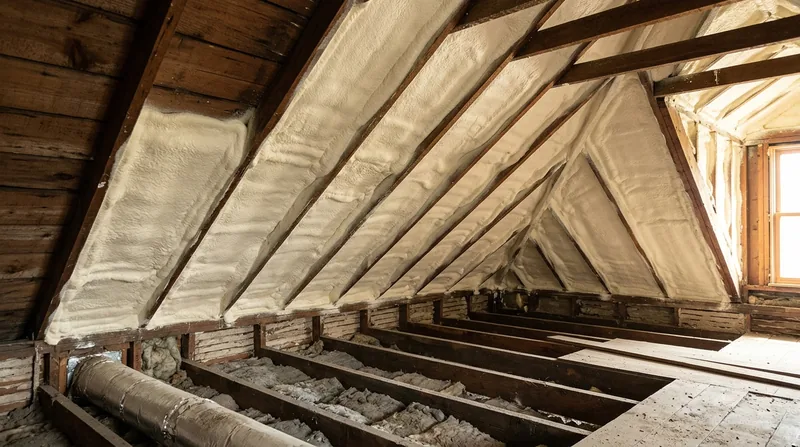




Attic spray foam insulation in Peoria seals the ceiling plane where warm, moist indoor air escapes during winter and drives heat loss and moisture into wall cavities and attics. Peoria's mix of early-1900s frame homes on the West Bluff, postwar ranches across the city, and newer subdivisions in Morton and Washington all sit in IECC climate zone 5A, where cold winters and humid summers push air through ceiling penetrations, rim joists, and attic bypasses. Once that air leaks escape, heating bills climb fast and upper rooms stay cold. We spray closed-cell or open-cell foam directly onto the attic deck to seal those leaks, stop air movement, and restore the thermal boundary where it belongs. The result is a warmer attic, lower winter heating costs, and a moisture-controlled shell that performs year-round.
Why Attic Air Leaks Matter in Peoria Homes
Peoria's housing stock spans a century of building practice, from uninsulated cavities in West Bluff Victorians to settled fiberglass in 1950s ranches to tighter modern shells in Washington and Dunlap. Nearly every house in this climate zone loses energy through the attic ceiling plane. Warm indoor air, loaded with moisture from kitchens, bathrooms, and living spaces, rises and seeks the path of least resistance. When it finds gaps around electrical boxes, HVAC penetrations, ductwork, and rim joists, it escapes into the attic. In winter, that heat is gone and the energy bill reflects it. In summer, the reverse happens: hot attic air leaks down into cooled living spaces. The moisture that travels with that air condenses in wall cavities and attic framing, feeding mold and rot over time.
- Ceiling air leaks account for 20 to 40 percent of total home heat loss in zone 5A climates.
- Fiberglass batts and blown-in insulation do not stop air movement; they slow conductive heat loss only.
- Spray foam seals the leak at the source and provides both air and thermal barriers in one pass.
- Peoria's cold winters and humid summers make moisture control at the attic boundary critical to long-term framing health.
Getting the ceiling plane sealed is the first step to controlling energy loss and moisture in any Peoria home. For guidance on what applies at your address, contact the City of Peoria Building Department regarding ventilation and thermal barrier code for attic work.
Key info: West Bluff and Peoria Heights homes built before 1960 typically have attics with no air sealing and minimal insulation. A 1,500-square-foot attic deck in one of these homes can leak the equivalent heat of leaving a basement window open all winter. Spray foam closes that leak permanently.
How We Spray Foam Your Attic Deck: The Process
Attic spray foam work starts with a site visit to map the deck, identify penetrations, and measure thickness and R-value targets for your home. We assess existing insulation, note any moisture damage or settling, and confirm what the local building code requires for your address. Once you approve the estimate, we schedule the work and prepare the attic by clearing debris and setting up mechanical ventilation. The spray crew applies foam in controlled passes, holding thickness and ratio to manufacturer spec, then removes temporary ventilation after cure. The result is a continuous, sealed thermal boundary from rim to rim.
- We visit your attic, measure the deck, and identify all ceiling penetrations and air leak points.
- We write an estimate with R-value and thickness specs for your Peoria address and building code.
- You approve the scope, we schedule work around your calendar and weather conditions.
- We set up mechanical ventilation in the attic to manage vapor during spray and cure.
- We spray foam in controlled passes, maintaining manufacturer ratio and drum temperature throughout.
- We allow the specified cure time (typically 24 to 48 hours) before re-entry and final inspection.
- We document the R-value, thickness, and coverage in a completion report for your records.
This step-by-step approach ensures the foam bonds correctly, cures fully, and delivers the R-value promised on your estimate. For a detailed look at our approach to air sealing alongside insulation, see our air sealing service page.
Local example: A ranch home in East Peoria with a 1,200-square-foot attic deck and settled fiberglass typically needs 4 to 6 inches of closed-cell foam to achieve R-28 at the ceiling plane and seal all rim joist bypasses. The work takes one day, and the home is ready for normal use within 48 hours. Winter heating bills typically drop 15 to 25 percent once the deck is sealed and the rim joist is addressed.
Attic Spray Foam Methods: Closed-Cell vs. Open-Cell
| Method | Description | Best for Peoria Attics |
|---|---|---|
| Closed-Cell Foam | Dense, rigid foam with R-6.5 per inch. Vapor-impermeable once cured. Stops air and moisture at the deck surface. | Sealed roof decks, vented attics with moisture concerns, homes where rim joist and attic must be vapor-controlled together. |
| Open-Cell Foam | Lighter, semi-rigid foam with R-3.6 per inch. Permeable to vapor. Stops air movement but allows drying to the interior. | Standard vented attics in older homes, where deeper insulation is needed and attic ventilation is intact. |
| Hybrid or Top-Up | Foam air seal (2 to 4 inches closed-cell) over existing blown-in insulation. Seals bypasses without full replacement. | Homes in Morton and Washington with sound insulation that has settled or developed air leaks; cost-conscious retrofit. |
| Full Removal and Replacement | We remove failed, settled, or contaminated insulation and spray new foam to spec. Includes disposal and final R-value documentation. | Attics with failed fiberglass, prior water damage, or where prior work left gaps and voids. |
The choice between closed-cell and open-cell depends on your attic's ventilation status, moisture history, and whether you are sealing the roof deck or the attic floor. We assess your specific situation on site and recommend the method that delivers the best performance for your Peoria address and climate zone. For more detail on closed-cell properties and R-value, see our closed-cell spray foam page.
Attic Spray Foam Insulation Cost in Peoria: What to Expect
Attic spray foam pricing in Peoria typically starts at $1.50 to $2.50 per square foot of deck coverage, depending on the method, R-value target, and existing insulation condition. A 1,200-square-foot attic with closed-cell foam to R-28 generally ranges from $1,800 to $3,000. An open-cell job on the same deck may run $1,400 to $2,200. A hybrid top-up (foam air seal over existing insulation) is typically $800 to $1,500 for the same space. These ranges reflect Peoria market conditions and the factors that move the price: deck size, access difficulty, removal of failed insulation, foam type, and R-value target.
Several factors affect the final cost. A tight attic with limited access costs more to spray than an open, clear deck. Removal of settled fiberglass or failed prior foam adds labor and disposal fees. Sealed roof decks (common in newer homes in Washington and Morton) require thicker foam and cost more than attic-floor jobs. Thicker foam for higher R-values (R-38 or R-49) increases material cost proportionally. The best way to know what your job will cost is to get a written estimate with R-value and thickness specs from us and one or two other local contractors. We provide free estimates within 24 hours at (309) 271-6856, and the estimate includes a breakdown of materials, labor, and any removal work needed.
For a full pricing overview and service-area details, visit our pricing page.
What to Look for When Hiring an Attic Spray Foam Contractor Near Me in Peoria
Hiring the right spray foam contractor is critical because the work is permanent, it affects your home's performance for decades, and a poor installation can leave odors, uneven coverage, or inadequate R-value. Peoria has local independent shops, national franchise operations, and out-of-state crews that travel the region. The honest contractor is the one who shows up on time, provides a written estimate with R-value and thickness, answers your questions about method and cure time, and explains what the local building code requires at your address. Avoid any contractor who quotes a price without visiting the attic, promises immediate re-entry before cure is complete, or cannot verify insurance.
- Verify that the contractor is fully insured and ask for a certificate of insurance naming your address.
- Get a written estimate that includes R-value, thickness in inches, foam type, and total square footage of the deck.
- Ask about the cure time (typically 24 to 48 hours) and mechanical ventilation during spray to manage vapor and odor.
- Check references from recent jobs in Peoria, East Peoria, or Pekin, and ask about final odor and performance.
- Confirm that the contractor has worked with your local building department and understands attic ventilation and thermal barrier code for your address.
- Compare estimates from at least two local contractors before you commit; pricing that is far below market usually signals corners cut elsewhere.
Once you have narrowed your choice, contact us at our contact page to request a free estimate or call (309) 271-6856. We have been in business since 2011 and serve Peoria, East Peoria, Pekin, Morton, Washington, and surrounding communities with locally-based crews and full insurance coverage.
Attic Spray Foam Insulation in Peoria: Pricing Guide
| Service | Price | Details |
|---|---|---|
| Open-Cell Foam Attic Spray | Starting at $1.50/sq ft | Lighter foam for vented attics in older Peoria homes; includes air sealing at penetrations and blown-in compatibility |
| Closed-Cell Foam Attic Spray | Starting at $2.00/sq ft | Denser foam for sealed roof decks or moisture-prone attics; higher R-value per inch, vapor control, rim joist integration |
| Hybrid Top-Up or Partial Coverage | Starting at $1.75/sq ft | Foam air seal layer over existing settled insulation; cost-effective retrofit for homes in Washington and Morton with sound base insulation |
| Insulation Removal and Replacement | On estimate | Full tearout of failed fiberglass or prior foam, haul-away, and new spray application; requires site assessment to price |
| Travel and Setup | Included | No separate mileage or travel charge for Peoria, East Peoria, Pekin, Morton, Washington, and surrounding service areas |
| Free Written Estimate | No charge | Includes attic inspection, R-value and thickness specs, foam type recommendation, and 24-hour response at (309) 271-6856 |
Indicative pricing, the exact cost depends on square footage, finish, and site access. Free personalized estimate within 24h at (309) 271-6856.


