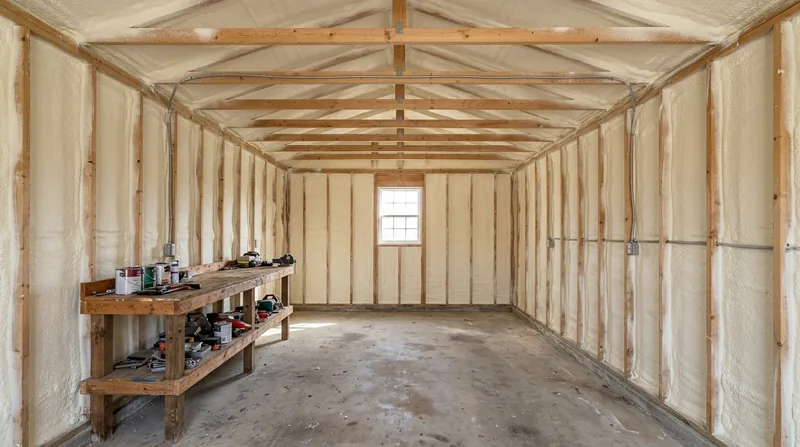




Garage spray foam insulation in Peoria transforms an unheated shell into a usable workshop or storage space that holds temperature through Peoria's cold winters and stays manageable in summer heat. Across Peoria, East Peoria, Morton, and Washington, most detached garages sit uninsulated, losing heat through thin metal or wood-frame walls and ceiling cavities open to the attic above. In IECC climate zone 5A, where winter heating bills climb fast and humidity drives moisture into cold walls, an uninsulated garage becomes a thermal sieve that bleeds energy from the main house and makes the space itself unusable for any task beyond parking. We spray foam the walls and ceiling to seal air leaks, hold heat, and give you a garage that functions as a real workspace year-round. The work is fast, the payoff is immediate, and the cost is straightforward once you understand what goes into it.
Why Garage Spray Foam Insulation Matters in Peoria and Tazewell County
Garages in Peoria's postwar neighborhoods and newer subdivisions are built to keep weather out, not to hold heat in. A standard single-car garage with no insulation in the walls or ceiling will sit 10 to 20 degrees colder than the outdoors on a winter day because the concrete slab and framing pull heat away and air leaks at the rim joist and ceiling plane accelerate the loss. If your garage is attached to the house, that cold shell acts as a thermal drain on the adjacent living space, forcing your furnace to work harder to maintain comfort in rooms that border the garage. Many homeowners in Peoria and surrounding areas tolerate a cold garage for storage, but once the space becomes a workshop, hobby room, or extended living area, the lack of insulation and air sealing becomes a real cost and a comfort problem.
- Spray foam seals air leaks at the rim joist, band joist, and ceiling plane where cold drafts enter and warm air escapes.
- Closed cell foam holds an R-value of 6 to 7 per inch, so a 2-inch application in the ceiling delivers R-12 to R-14 and meaningful temperature retention.
- Open cell foam at R-3.5 to R-3.8 per inch is the lower-cost option for garages where sound dampening and vapor permeability matter more than peak thermal resistance.
- Spray foam adheres to wood, metal studs, and concrete, so there are no gaps or settling like blown-in or batts, and no thermal bridging through the frame.
- A finished garage space stays warm enough in winter for hand tools, hobby work, and temporary occupancy, and stays cooler in summer because the foam resists solar heat gain through the roof.
Once spray foam is in place, your garage becomes a conditioned space instead of a thermal liability, and the energy cost of heating or cooling the main house drops because you are no longer fighting heat loss through an uninsulated shell.
Key info: In Peoria and East Peoria, attached garages with uninsulated ceilings transfer cold air directly into attics and living spaces above. Spray foam the garage ceiling and seal the rim joist to break that thermal path. Detached garages in Morton and Washington gain usable square footage once insulated and heated, turning a cold storage shed into a real workshop.
For guidance on permitting and building code compliance in your city, check with your local building department or visit the Illinois Emergency Management & Homeland Security Agency for state-level construction standards that apply in Peoria and Tazewell County.
How We Insulate and Air Seal Your Garage in Peoria
Garage spray foam insulation starts with a site walkthrough to assess the structure, identify air leaks, and determine whether the walls, ceiling, or both need coverage. We check the rim joist where the foundation meets the frame, the band joist above it, any penetrations in the ceiling for electrical or HVAC runs, and the condition of the existing framing to make sure the substrate is sound and dry. Once we understand the scope, we set up mechanical ventilation to manage off-gassing during cure, apply foam at the thickness and R-value you need, and verify coverage with a tape measure and visual inspection. We then discuss re-entry timing, typically 24 to 48 hours depending on foam type and ambient conditions, so you know when the space is safe to occupy and use normally.
- We walk the garage and identify all air leak paths, including rim joist gaps, band joist cracks, and ceiling penetrations for ducts or electrical.
- We apply closed cell or open cell foam depending on your R-value target, budget, and whether sound dampening or vapor permeability is a priority.
- We measure thickness on each pass to confirm R-value and prevent over-spray, which wastes material and creates waste disposal headaches.
- We set up mechanical ventilation and post a re-entry window so you know when the garage is ready to use.
- We clean up and remove all waste from the site, leaving the garage ready for drywall, storage, or immediate use depending on your plan.
The entire process, from setup to cleanup, typically takes one to two days depending on garage size and complexity. For larger jobs or garages with extensive air sealing needs, we also offer air sealing services to address rim joists and other thermal boundaries.
Local example: A 400-square-foot detached garage in Peoria with uninsulated wood-frame walls and an open ceiling takes one day to spray foam the walls to R-15 (closed cell, 2.5 inches) and the ceiling to R-21 (closed cell, 3.5 inches). A 500-square-foot attached garage in Morton with a rim joist air leak and an attic ceiling penetration typically requires a half day to seal the rim joist and spray the ceiling cavity, plus a second visit if drywall needs to be removed to reach the rim.
Garage Spray Foam Insulation Methods: Closed Cell vs. Open Cell
| Approach | Description | Best for |
|---|---|---|
| Closed Cell Spray Foam | High-density foam at 2.5 to 3.5 inches per application, R-value 6 to 7 per inch, vapor-impermeable, resists moisture and air infiltration, holds structural strength. | Garage walls and ceilings exposed to outdoor temperature swings, attached garages where thermal performance matters, spaces where vapor control is critical. |
| Open Cell Spray Foam | Low-density foam at 3.5 to 5.5 inches per application, R-value 3.5 to 3.8 per inch, vapor-permeable, lighter, lower cost, absorbs sound, allows wall assemblies to dry. | Detached garages where R-value needs are modest, spaces where sound dampening (tools, music) is desired, budget-conscious projects with dry substrates. |
| Rim and Band Joist Sealing | Closed cell foam applied to the rim joist where the foundation meets the sill plate, typically 1 to 2 inches, seals air leaks and prevents moisture wicking from concrete. | Attached garages, any garage where the rim joist is exposed, basements or crawl spaces under garages, older Peoria homes with loose or missing rim joist insulation. |
| Ceiling-Only Coverage | Spray foam applied to the garage ceiling and any attic-facing penetrations, leaving walls uninsulated, lower cost and faster install, addresses the largest heat loss path. | Detached garages in Peoria where the primary heat loss is through the roof, spaces used for storage or occasional work rather than daily occupancy, budget-first projects. |
The choice between closed cell and open cell depends on your R-value target, the garage's exposure to outdoor temperature, and your budget. Closed cell is the premium choice for thermal resistance and vapor control; open cell is the practical choice for detached garages where R-15 to R-21 is acceptable and cost matters. For more details on closed cell foam performance and applications, or to explore open cell options for garages, contact us for a site-specific recommendation.
Garage Spray Foam Insulation Cost in Peoria: What to Expect
Garage spray foam insulation starts at around $1,200 for a small single-car garage with ceiling-only coverage and open cell foam. The final cost depends on several concrete factors: the size of the garage (a 400-square-foot space costs less than a 600-square-foot space), whether you insulate walls, ceiling, or both, the R-value you target (closed cell costs more per board foot than open cell), access to the rim joist (if it requires drywall removal or crawl space entry, labor increases), and the condition of the existing structure (if framing is wet or contaminated, we address that first or we walk away). An attached garage in Peoria with both walls and ceiling insulated in closed cell foam typically runs $2,500 to $4,000 depending on size and complexity. A detached garage with ceiling-only open cell coverage usually lands between $1,200 and $2,000.
The best way to know your actual cost is to get a free written estimate that specifies R-value, foam thickness, and board feet of material. We provide that within 24 hours at (309) 271-6856, and we encourage you to get two or three quotes so you can compare not just price but scope, material choice, and warranty terms. For a detailed breakdown of pricing across all our services, visit our pricing page.
Cost example: A 500-square-foot attached garage in East Peoria with a rim joist air leak and an uninsulated ceiling: closed cell foam on the rim (R-12, 2 inches) plus closed cell on the ceiling (R-21, 3.5 inches) typically runs $2,800 to $3,400 including labor and cleanup. If you choose open cell for the ceiling instead, the same garage drops to $1,800 to $2,300. A 300-square-foot detached garage in Washington with ceiling-only open cell coverage (R-15, 4 inches) usually costs $1,200 to $1,600.
What to Look for When Hiring a Garage Spray Foam Insulation Contractor Near Peoria
Choosing a spray foam insulation contractor is a decision that affects your garage's performance and your peace of mind for years. The market includes local independent shops, national franchises, and transient crews that spray a job in an afternoon and disappear when the smell lingers or the foam doesn't cure right. A credible contractor near Peoria should be fully insured, provide written estimates with R-value and thickness specifications (not vague price-per-square-foot), offer references you can actually call, and be clear about re-entry timing and curing conditions. Ask whether they set up mechanical ventilation during cure, whether they measure thickness on each pass, and what their workmanship warranty covers. If a contractor promises immediate re-entry, guarantees energy savings in dollars, or quotes a price far below market with no inspection, those are red flags that the job will cut corners.
- Confirm the contractor is fully insured and ask to see a current certificate of insurance that names your address as additional insured.
- Request a written estimate that lists R-value, foam thickness in inches, total board feet, and the cost breakdown so you can compare fairly across quotes.
- Ask for at least three references from garage insulation jobs completed in the last two years, and actually call them to ask about quality, cleanup, and whether any issues arose after the job.
- Verify that the contractor will set up mechanical ventilation during cure and post a re-entry window of 24 to 48 hours, not promise immediate use.
- Confirm that the contractor checks the substrate for moisture or contamination and will not spray over a wet or damaged surface.
- Ask about the local building department's requirements for your city (Peoria, East Peoria, Morton, Washington, or another area) and whether a permit applies to your garage insulation project.
Once you have narrowed your list to one or two contractors, contact us at Peoria Spray Foam Insulation for a free estimate and a conversation about your specific garage and goals. We have been serving Peoria and Tazewell County since 2011, and we stand behind every job with a detailed estimate and honest guidance on what will actually solve your problem.
Garage Spray Foam Insulation in Peoria: Pricing Guide
| Service | Price | Details |
|---|---|---|
| Garage ceiling only, open cell foam | Starting at $1,200 | Small single-car garage, 300-400 sq ft, open cell R-15 to R-18, includes labor and cleanup |
| Garage walls and ceiling, closed cell foam | Starting at $2,500 | Attached or detached garage, 400-500 sq ft, closed cell R-15 to R-21, thermal and air sealing |
| Rim joist sealing plus ceiling insulation | Starting at $1,800 | Attached garage with air leak at rim, closed cell rim seal plus open or closed cell ceiling coverage |
| Large or complex garage insulation | On estimate | 600+ sq ft, multiple zones, drywall removal needed, or existing foam remediation requires site visit |
| Travel | Included | No mileage fee or travel charge within Peoria, East Peoria, Morton, Washington, and surrounding service areas |
| Free written estimate | Free | Includes R-value, thickness, board feet, and labor cost; response within 24 hours at (309) 271-6856 |
Indicative pricing, the exact cost depends on square footage, finish, and site access. Free personalized estimate within 24h at (309) 271-6856.


