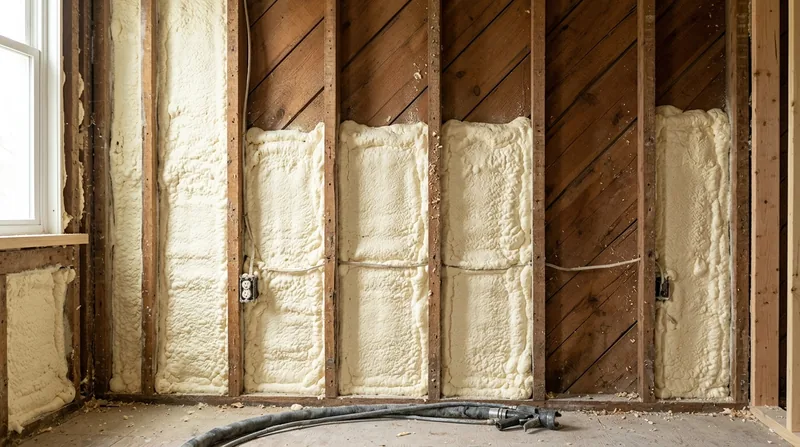




Open Cell Spray Foam Insulation in Peoria fills the cavities in the early-1900s frame and brick homes that line the West Bluff and Peoria Heights, where original wall construction left gaps and settling insulation that no amount of weatherstripping will fix. Open cell foam expands to conform to the shape of wall cavities without adding structural weight, softens drafts in these older homes, and quiets sound transmission between rooms. In Peoria's cold and humid climate zone 5A, where indoor air drives moisture outward into cold walls all winter, sealing those cavities stops both the draft and the moisture path before it reaches the sheathing. This is different from closed cell foam, which is denser and better suited to rim joists and metal buildings where moisture control and structural support matter most. Open cell is the right choice for retrofitting inhabited older homes where weight and cost matter, and where the walls themselves are sound but the insulation is not.
Why Open Cell Spray Foam Matters in Peoria's Older Homes
Peoria's housing stock tells the story of why open cell foam works here. The West Bluff and Peoria Heights neighborhoods are built on early-1900s frame and brick homes where wall cavities were never fully insulated or were insulated with materials that have settled thin over a century. Postwar ranches across Peoria and East Peoria often carry fiberglass batts installed decades ago that have compressed and lost their R-value. These homes lose heat and cold equally through their walls, driving heating bills up in winter and air conditioning costs higher in summer. Open cell foam retrofitted into existing wall cavities closes those air leaks and restores R-value without requiring demolition or exterior work.
- Open cell foam expands to fill irregular cavities and settles around existing wiring, plumbing, and framing without adding weight to the wall structure.
- The foam conforms to the exact shape of the cavity, leaving no voids where air can move or moisture can accumulate.
- It reduces drafts and cold spots in rooms that are always uncomfortable, especially in corner bedrooms and bathrooms on exterior walls.
- Open cell is less dense than closed cell foam, making it the cost-effective choice for attics and wall retrofits where structural load is not a concern.
- The material cures to a soft, semi-rigid state that allows for future access to wall cavities if plumbing or electrical work is needed.
These benefits add up to lower energy bills, fewer drafty rooms, and a warmer home in winter without tearing out walls or adding significant weight to the structure.
Key info: In Peoria Heights and the West Bluff, homes built before 1920 often have wall cavities that are either empty or filled with settled cellulose or mineral wool. Open cell spray foam retrofitted into those cavities can reduce heating costs by 15 to 40 percent, depending on the existing insulation and air leakage. The Illinois energy code does not prohibit open cell foam in walls, but the installation must include a thermal barrier (usually drywall or closed cell foam) on the interior side to meet the fifteen-minute ignition barrier requirement. Always verify the specific requirement with your local building department before work begins.
For more on how spray foam fits into your overall insulation strategy, see our guide to Closed Cell Spray Foam Insulation, which is often paired with open cell in hybrid applications.
How We Install Open Cell Spray Foam in Peoria Homes
Open cell spray foam installation in Peoria homes starts with a detailed site walk. We identify the walls that are drafty or uncomfortable, check for moisture, active leaks, or settling insulation, and confirm that the wall cavity is sound and dry. If the substrate is wet, contaminated, or actively leaking, we stop and refer you to the appropriate specialist. Once we confirm the wall is ready, we set up temporary ventilation and begin spraying in controlled passes, building thickness layer by layer to the specified R-value and density. The foam expands to fill the cavity, and we stop it at the plane of the framing so that the drywall or sheathing on the interior side can be reinstalled. Curing time is typically 24 to 48 hours before re-entry, and we provide a written estimate that specifies the R-value, thickness, and board-foot volume before work begins.
- We perform a free on-site estimate and identify which walls are the best candidates for open cell foam based on drafts, settling insulation, and structural condition.
- We confirm that the wall substrate is dry and sound, and we walk away if moisture or active leaks are present until they are fixed.
- We set up mechanical ventilation during the spray process to manage fumes and ensure safe working conditions for the household.
- We spray the foam in controlled passes, building to the specified thickness and density, and we do not promise immediate re-entry.
- We provide a written receipt that documents the board-foot volume sprayed, the R-value per inch, and the total thickness in each wall cavity.
This methodical approach ensures that the foam is installed correctly, that the home is safe during and after the cure, and that you have documentation of what was done and to what specification.
Local example: A 1910s frame home in Peoria Heights had two exterior bedrooms that were always cold, even with the heat turned up. The walls had settled cellulose that had compressed to about R-3 per inch. We removed the interior trim, drilled access holes in the drywall, sprayed open cell foam to R-3.5 per inch and 5.5 inches thick (total R-19 in the 2x6 cavities), and patched the drywall. The bedrooms were warm by the next heating season, and the homeowner recovered the cost difference in lower heating bills within three years.
See our Wall & Injection Foam Insulation page for information on retrofitting closed walls without removing trim or drywall.
Open Cell Spray Foam Installation Methods
| Approach | Description | Best for |
|---|---|---|
| Cavity Fill (Open Walls) | Spray foam directly into wall cavities from the interior after trim removal or from the exterior after sheathing removal. Foam expands to fill the entire cavity and is trimmed flush to the framing. | Older homes being renovated, homes with settling insulation, retrofit projects where the wall is already open. |
| Injection (Closed Walls) | Small holes drilled in the drywall or sheathing at intervals along the wall. Foam is injected through the holes, fills the cavity, and holes are patched. No drywall removal required. | Homes where interior trim or drywall must remain intact, retrofit of 1960s to 1990s homes with empty or settled cavities. |
| Attic Walls and Sloped Ceilings | Open cell foam sprayed into the rafter bays of finished attics or into the sloped ceilings of second-story rooms to achieve higher R-values than fiberglass batts and to seal air leaks at the ceiling plane. | Finished attics with cold rooms, second-story bedrooms that are too hot in summer or too cold in winter, sealed attic conversions. |
| Sound Dampening | Open cell foam sprayed into wall cavities and ceiling cavities in shared walls between bedrooms or between living spaces and mechanical rooms to reduce sound transmission. | Homes with thin walls, apartments or duplexes with shared walls, home theaters or music rooms, any interior wall where noise isolation is desired. |
Open Cell Spray Foam Insulation Cost in Peoria: What to Expect
Open cell spray foam in Peoria starts at approximately $0.55 to $0.75 per board foot, which translates to a typical wall retrofit of 500 to 1,000 board feet costing between $275 and $750 depending on the extent of the work, the accessibility of the walls, and the R-value target. A full-house wall retrofit can run $2,000 to $4,500 or more, depending on how many walls are treated and whether the work requires drywall removal or injection drilling. Factors that move the cost upward include the number of walls to be insulated, the presence of existing insulation that must be removed first, the need for drywall patching or trim reinstallation, and the complexity of the wall geometry (cathedral ceilings, knee walls, or irregular framing). Factors that move it downward include jobs where walls are already open during renovation, where existing insulation is thin or absent, and where access is straightforward.
The best way to get an accurate number is to request a free on-site estimate. Call us at (309) 271-6856 and we will schedule a walk-through, assess the walls, measure the cavity dimensions, and provide a written estimate with the board-foot volume, R-value per inch, and total cost before any work begins. We typically respond within 24 hours.
For a detailed breakdown of pricing across all our services, visit our Pricing Overview.
What to Look for When Hiring a Spray Foam Contractor Near Peoria
Spray foam insulation is a specialized trade, and the difference between a careful installation and a careless one shows up in the smell, the energy performance, and the longevity of the foam. When you are comparing contractors near Peoria or in surrounding areas like East Peoria, Morton, or Washington, look for specific markers that separate a professional from a rig-and-run operation. A professional contractor will provide a written estimate that specifies the R-value, thickness, and board-foot volume before work begins, will set up mechanical ventilation during the spray, will not promise immediate re-entry, and will be reachable after the job is done if questions arise. A contractor who gives you a price per square foot with no mention of R-value or thickness, who promises you can re-enter the home the same day, or who is unreachable after the job is a red flag.
- Request a written estimate that includes the R-value per inch, the total thickness in each wall cavity, and the board-foot volume being sprayed.
- Ask whether the contractor will set up mechanical ventilation during the spray process and what the re-entry window is (typically 24 to 48 hours).
- Verify that the contractor is fully insured and ask for a certificate of insurance that names your address as an additional insured.
- Check whether the contractor is registered with the city or county where the work will be performed, and verify that any required permits are being pulled.
- Ask for references from recent jobs in Peoria, East Peoria, or nearby towns, and call at least two to confirm that the work was done on time and to spec.
- Understand whether the work requires a permit and what the local building department's thermal barrier requirement is for open cell foam (usually 15-minute ignition barrier).
If you are ready to move forward, contact us for a free estimate and we will walk you through the process step by step.
Open Cell Spray Foam Insulation in Peoria: Pricing Guide
| Service | Price | Details |
|---|---|---|
| Wall Retrofit (Open Cell) | Starting at $0.55/board ft | Spray-applied into existing wall cavities; cost varies with cavity depth, wall length, and R-value target |
| Injection Foam (Closed Walls) | Starting at $0.65/board ft | Holes drilled and foam injected into inhabited walls; price includes drilling, injection, and drywall patching |
| Attic Sloped Ceilings | Starting at $0.60/board ft | Rafter bays and sloped second-story ceilings; cost reflects roof pitch, rafter spacing, and access difficulty |
| Full-House Wall Retrofit | On estimate | Multiple rooms, drywall removal, or insulation removal first; requires on-site measurement and scope confirmation |
| Travel and Setup | Included | No separate mileage fee for jobs in Peoria, East Peoria, Morton, Washington, and surrounding service areas |
| Free Estimate | No obligation | Written estimate with R-value, thickness, and board-foot specs; response within 24 hours at (309) 271-6856 |
Indicative pricing, the exact cost depends on square footage, finish, and site access. Free personalized estimate within 24h at (309) 271-6856.


