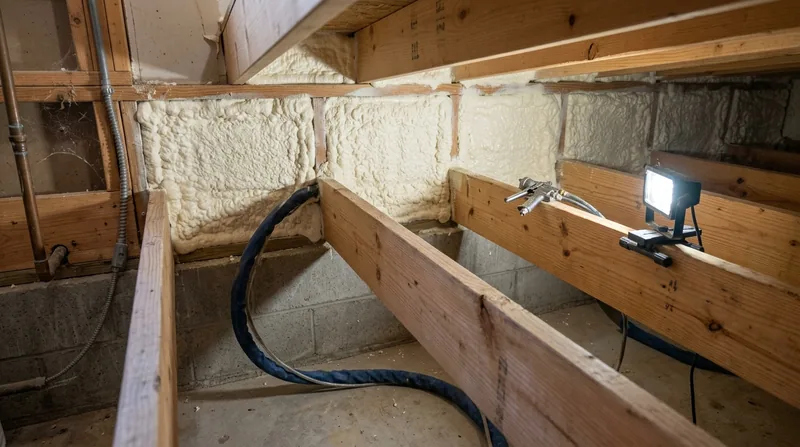




Closed cell spray foam insulation in Peoria is the dense, moisture-resistant answer to the basement dampness and rim joist cold that plague nearly every full-basement home in Greater Peoria. Peoria's housing stock spans early-1900s frame and brick homes on the West Bluff and in Peoria Heights, postwar ranches across the city and in East Peoria, and newer subdivisions in Morton, Washington and Dunlap. Every one of these homes sits over a full basement with long runs of rim joist where cold outside air meets warm basement air, and that's where drafts, heat loss, and moisture settle in. Winter heating season drives warm indoor air outward into cold walls and attics, and air leaks at the ceiling plane and at rim joists are usually where that moisture and heat loss start. Closed cell foam adds rigid, dense insulation exactly where moisture collects, handles the dampness that builds up every winter, and stops the air movement that carries heat and cold through your basement rim. We've been doing this work in Peoria since 2011, and we understand the specific failure modes of this climate and building stock.
Why Closed Cell Spray Foam Matters in Peoria Basements and Rim Joists
Peoria's climate is IECC zone 5A: cold and humid in winter, hot and humid in summer. That means your basement rim joist and band joist live at the boundary between conditioned air inside and raw outdoor temperature outside, and moisture condenses there year-round. Older homes on the West Bluff and in Peoria Heights were built with rim cavities that were never sealed, and that shows up as cold basements and high winter heating bills. Postwar ranches across Peoria and East Peoria often carry rim insulation that has settled or failed over decades. Newer homes in Morton and Washington have tighter shells but still lose energy through rim joists and foundation band transitions. Closed cell foam stops air infiltration at the rim, resists moisture, and maintains its R-value even when dampness is present.
- Closed cell foam reaches R-6 per inch, so 2 inches of closed cell delivers R-12 rigid insulation in a tight rim cavity.
- The foam's density and closed-cell structure resist water absorption and vapor transmission better than open cell or fiberglass.
- Foam adheres directly to rim band, band joist, and foundation ledge, sealing air leaks at the same time insulation is installed.
- Closed cell foam cures hard and does not settle, so R-value stays constant for decades in Peoria's freeze-thaw and humidity cycles.
- The material handles the moisture load that condenses at the rim without degrading or supporting mold growth when installed correctly.
These factors make closed cell the standard choice for Peoria rim joist and basement band insulation, especially in homes with damp or exposed basements.
Key info: A West Bluff home with 80 linear feet of exposed rim joist and a damp basement history will see the biggest payoff from closed cell foam: the material stops cold air from entering the rim, eliminates the condensation surface, and cuts the drafty-basement complaint that plagues older Peoria homes built before rim insulation became standard.
For detailed guidance on whether closed cell or open cell spray foam insulation fits your home, call us at (309) 271-6856 or request a written estimate with R-value and thickness specs.
How We Install Closed Cell Spray Foam in Peoria Rim Joists and Basements
Closed cell spray foam is mixed on site to the manufacturer's exact ratio and temperature, sprayed into rim cavities and band joist voids in controlled passes, and cured under mechanical ventilation before the space is reoccupied. The process requires precision: each pass is measured for thickness, the foam is applied at the correct pressure and nozzle angle, and the space is kept clear during cure to prevent off-gassing. We verify substrate moisture before any foam is applied. If a rim or band joist is wet or actively leaking, we stop, identify the source, and do not spray until the substrate is dry. This is not a caveat, it's a selling point: we fix the moisture first or we walk away.
- We inspect the rim joist and band joist for moisture, active leaks, and structural damage before quoting.
- We clean debris and seal large gaps or cracks before spraying to ensure foam bonds and fills properly.
- We spray closed cell foam in controlled thickness passes, typically 1.5 to 2.5 inches per pass, to reach the specified R-value without waste.
- We provide mechanical ventilation during cure and enforce a re-entry window of 24 to 48 hours before basements and crawl spaces are occupied.
- We trim excess foam flush with the rim face and leave the space ready for any basement finishing or mechanical work that follows.
The result is a sealed, insulated rim joist that stops drafts, resists moisture, and performs consistently through Peoria's freeze-thaw winters and humid summers.
Real example: A home in Morton with 120 linear feet of rim joist and a history of cold basement corners received 2 inches of closed cell foam applied in two passes. The homeowner reported warmer basement floors within one week and a noticeable drop in winter heating bills the following January. The foam adhered to the rim band, sealed the rim-to-foundation joint, and stopped the cold air that had been drafting into the basement for years.
For more on rim joist and band joist spray foam and how it pairs with crawl space or basement insulation, visit our dedicated service page or call (309) 271-6856.
Closed Cell Spray Foam Application Methods and When Each Works Best
| Approach | Description | Best for |
|---|---|---|
| Rim Joist and Band Joist Spray | 2 to 2.5 inches of closed cell foam applied directly to the rim band, band joist, and foundation ledge, sealing air leaks and insulating the thermal break between basement and outdoors. | Basements with exposed rim, damp conditions, or cold basement corners; homes built before 1980 with uninsulated or settled rim insulation; postwar ranches and newer homes needing rim thermal break upgrade. |
| Crawl Space Rim and Floor Band | Closed cell foam on crawl space rim joists, band joists, and rim ledge to stop cold air infiltration and control moisture in unconditioned or vented crawl spaces. | Crawl spaces with exposed rim, high humidity, or cold floors above; homes in Peoria Heights and West Peoria with older crawl spaces that have never been insulated. |
| Basement Rim with Moisture Control | Closed cell foam applied only to rim and band joist, leaving basement walls and floor to be handled separately or left as-is, depending on moisture and finishing plans. | Basements that are finished or will be finished; homes where the goal is to stop rim infiltration and cold floors without insulating the full basement shell. |
| Foundation Band Retrofit on Older Homes | Closed cell foam injected or sprayed into existing rim cavities of homes built in the 1920s through 1970s, where the rim was built hollow or with no insulation. | West Bluff and Peoria Heights homes, early postwar ranches, and any Peoria-area home with a history of cold basements and high winter heating bills tied to rim infiltration. |
Closed Cell Spray Foam Insulation Cost in Peoria: What to Expect
Closed cell spray foam insulation in Peoria typically starts at $1.20 per board foot for rim joist and band joist work, with the final cost depending on the linear footage of rim to be covered, the thickness required to reach your target R-value, site access, and whether the substrate is dry and ready or needs moisture remediation first. A typical 100-linear-foot rim joist job with 2 inches of closed cell foam will run between $2,400 and $3,600 before any finishing or trim work. The cost moves up if the rim cavity is tight or has obstacles, if the basement is damp and requires drying time before spray, or if the work includes both rim joist and basement band transitions. The cost moves down if the rim is already partially insulated or if the cavity is wide and clean.
We provide written estimates with R-value and thickness specifications so you know exactly what you're paying for and why. Getting 2 to 3 estimates from different contractors is smart practice, but be cautious of quotes with no R-value listed, no thickness detail, or prices far below market. Those are markers of an installer cutting corners, skipping ventilation during cure, or making promises about immediate re-entry that violate the manufacturer's protocol.
For a detailed breakdown of closed cell foam costs and how they compare to open cell spray foam and other insulation methods, visit our pricing page or call (309) 271-6856 for a free, no-obligation estimate.
What to Look for When Hiring a Closed Cell Spray Foam Contractor Near Peoria
Choosing the right spray foam contractor in Peoria means verifying that the installer is fully insured, has a local address and local reputation, and can explain the difference between closed cell and open cell foam and why one is right for your job. The trade has two extremes: rig-and-run crews operating out of an out-of-state trailer who spray a job in an afternoon and disappear when the off-gassing smell won't go away, and national franchises with high overhead and generic answers. The local independent shop is positioned against both because honest guidance is the differentiator.
- Ask to see proof of full insurance coverage and verify that the policy covers spray foam installation and liability on your property.
- Request a written estimate that includes R-value per inch, total thickness in inches, and board footage, so you can compare apples to apples with other quotes.
- Ask about the curing process: mechanical ventilation during cure and a stated re-entry window of 24 to 48 hours are standard; any contractor promising immediate re-entry is cutting corners.
- Verify that the contractor will inspect your substrate for moisture before spraying; if a rim or band joist is damp, the foam will not bond and the job will fail.
- Check references from recent jobs in Peoria, Peoria Heights, East Peoria, or Morton, and ask those homeowners about their experience with curing smell, re-entry timing, and long-term performance.
- Understand what permits apply at your address by asking your local building department; permitting and registration vary from city to city across Greater Peoria, and the contractor should help you navigate what applies, not claim to pull all permits.
A reputable spray foam contractor in Peoria will give you straight answers, show you the math on R-value and thickness, and never promise energy savings as a percentage or a dollar amount. For a free, no-obligation estimate from a local contractor who has been doing this work in Peoria since 2011, contact us today or call (309) 271-6856.
Closed Cell Spray Foam Insulation in Peoria: Pricing Guide
| Service | Price | Details |
|---|---|---|
| Rim Joist and Band Joist Closed Cell Foam | Starting at $1.20/board ft | Includes substrate inspection, foam application at specified thickness, and trim. Cost varies by linear footage of rim and cavity width. |
| Crawl Space Rim and Floor Band Insulation | Starting at $1.20/board ft | Closed cell foam on rim joists and band joists in crawl spaces. Price depends on linear footage and whether moisture remediation is needed first. |
| Basement Rim Retrofit on Older Homes | Starting at $1.20/board ft | Retrofitting hollow or uninsulated rim cavities in pre-1980 homes. Cost increases if cavity is narrow, obstructed, or if substrate requires drying before spray. |
| Moisture Remediation and Drying | On estimate | If rim or band joist is wet or actively leaking, we identify and address the source before foam is applied. Drying time and scope determine cost. |
| Travel and Site Visit | Included | No separate charge for travel within Peoria, East Peoria, Pekin, Morton, Washington, and surrounding service areas. |
| Free Written Estimate | Free | Includes R-value, thickness, board footage, and labor. Response within 24 hours at (309) 271-6856. No obligation to book. |
Indicative pricing, the exact cost depends on square footage, finish, and site access. Free personalized estimate within 24h at (309) 271-6856.


