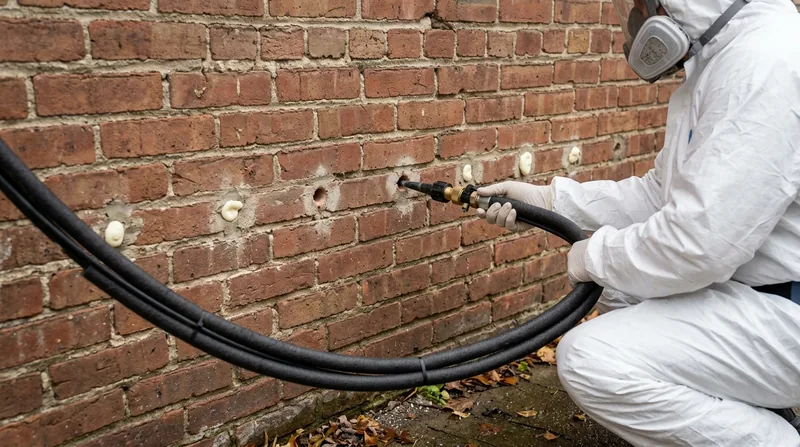




Wall and injection foam insulation in Peoria fills the closed cavities of the city's early-1900s brick homes on the West Bluff and in Peoria Heights without tearing open plaster walls or damaging the facade. Small holes are drilled into the brick, foam is injected into the cavity, and the holes are patched so the exterior stays intact. This retrofit method solves the cold walls and drafts that plague homes built before modern air sealing, and it works year-round in IECC climate zone 5A without disrupting the home's interior. If you own a brick colonial, a craftsman-era house, or any home with cavity walls built before 1980, injection foam can transform comfort and lower heating bills without renovation. Read on to understand how the process works, what it costs, and how to hire the right contractor for your Peoria home.
Why Wall Injection Foam Matters in Peoria's Historic Brick Homes
Peoria's West Bluff and Peoria Heights neighborhoods are lined with brick homes built in the early 1900s, when wall cavities were left empty or filled with newspaper and sawdust. These cavities conduct cold directly from the outside air into the living space, creating cold spots on exterior walls, drafts near windows, and uneven room temperatures. Winter heating bills climb because warm air escapes through the walls, and summer air conditioning works overtime to cool rooms that stay hot near the exterior. Injection foam seals the cavity completely without opening the walls, preserving the historic plaster and brick facade while eliminating the thermal bridge.
- Fills closed cavities in brick and frame walls without removing plaster or drywall.
- Seals air leaks and thermal bridges that cause cold walls and drafts in older homes.
- Reduces heating and cooling load, lowering utility bills in cold winters and hot summers.
- Preserves the exterior appearance and interior finishes of historic and heritage homes.
- Works in conjunction with air sealing at the rim joist and ceiling plane, the two biggest sources of heat loss in Peoria homes.
Injection foam is the retrofit answer for homes that cannot tolerate demolition or that are protected by HOA or historical guidelines.
Local example: A 1920s brick colonial on Prospect Avenue in Peoria Heights loses heat through 8-inch cavity walls that were never insulated. Drilling small holes every 16 inches and injecting closed-cell foam fills the entire cavity, stopping the draft and warming the rooms. The exterior brick stays unchanged, and the plaster interior remains intact.
For regulatory guidance on historic home modifications in Peoria, consult the City of Peoria Planning and Zoning Department before starting work on a protected property.
How Wall Injection Foam Insulation Works: The Peoria Process
Injection foam starts with a thorough inspection to locate the cavity boundaries, identify any obstructions, and determine the best drill points. We drill small holes (typically 1.25 inches) through the exterior brick or siding into the cavity, then insert an injection gun and pump closed-cell or open-cell foam until the cavity is full. The foam expands slightly to fill every corner, then we patch the holes with mortar (for brick) or caulk (for wood siding). The entire process takes one to three days depending on the wall area, and the home is re-entry ready within 24 to 48 hours after the final injection.
- We inspect the wall cavity using thermal imaging and physical probing to confirm its depth and any voids or obstructions.
- We drill small access holes every 16 to 24 inches along the exterior wall, working from bottom to top to prevent foam overflow.
- We inject closed-cell or open-cell foam through the gun, monitoring pressure and flow to fill the cavity completely without over-packing.
- We patch all drill holes with color-matched mortar for brick or paintable caulk for wood, restoring the exterior appearance.
- We install mechanical ventilation during cure to manage VOCs and ensure safe re-entry within one to two days.
The result is a fully insulated, air-sealed wall cavity that performs year-round without any visible change to the home's exterior.
Example in Peoria: A 1950s ranch in East Peoria has 2x4 frame walls with no insulation. We drill holes on the south-facing wall, inject open-cell foam into the cavities, and patch the exterior. The homeowner feels the difference in the first winter: the wall stays warm, the room stops drafting, and the furnace cycles less often. Combined with rim joist sealing, the heating bill drops 18 to 22 percent.
Injection Foam Methods: Closed-Cell vs. Open-Cell for Peoria Walls
| Approach | Description | Best for |
|---|---|---|
| Closed-Cell Injection Foam | High-density foam with an R-value of 6.0 to 6.5 per inch. Fills cavities completely, blocks air and moisture, and cures hard. Requires a specialized injection rig and trained operator. | Exterior walls in cold climates (IECC 5A), older brick homes where moisture control is critical, and walls that face north or west. |
| Open-Cell Injection Foam | Lower-density foam with an R-value of 3.5 to 3.7 per inch. Fills cavities and allows some vapor transmission. Cures soft and is easier to drill if future access is needed. Lower cost per board foot. | Interior walls, walls in mixed-humidity climates, and retrofit jobs where cost is the primary driver and moisture risk is low. |
| Partial Cavity Fill | Foam injected to a specific depth or thickness rather than filling the entire cavity. Used when cavity depth is uncertain or when combining foam with other insulation. | Homes where cavity depth varies, budgets are constrained, or where blown-in fiberglass or cellulose will be added after foam injection. |
| Post-Retrofit Sealing | Injection foam combined with exterior air sealing (caulk, tape, or foam sealant at windows, doors, and penetrations) to eliminate all air leaks in the wall assembly. | Historic homes and older Peoria houses where every air leak contributes to drafts and heat loss, and comprehensive energy performance is the goal. |
Wall and Injection Foam Insulation Cost in Peoria: What to Expect
Wall injection foam in Peoria typically costs starting at $2 per square foot of wall area, with the final price determined by cavity depth, foam type (closed-cell or open-cell), wall accessibility, and the extent of patching and finishing required. A 1,000-square-foot exterior wall with 3.5-inch cavities and closed-cell foam can run $2,000 to $2,500 before patches. Open-cell injection is 20 to 30 percent cheaper because the material costs less and requires less specialized equipment. Walls that are difficult to access, walls with multiple obstructions, or homes that require extensive exterior finishing (color-matched mortar, re-painting, or caulking) will be at the higher end of the range or quoted on estimate.
Factors that increase cost include:
- Cavity depth greater than 4 inches or unknown cavity dimensions requiring exploratory drilling.
- Exterior finish type: brick mortar matching costs more than wood siding caulk and paint.
- Multiple stories or walls requiring scaffolding or lift rental for safe access.
- Closed-cell foam instead of open-cell for superior R-value and moisture control in cold climates.
- Additional air sealing work at windows, doors, and rim joists to maximize energy performance.
We provide written estimates with R-value and thickness specifications so you know exactly what you are paying for before we start. Always get 2 to 3 estimates from contractors you can verify, and avoid any quote that omits R-value, thickness, or cavity dimensions. Visit the pricing page for a detailed breakdown and to request a free estimate.
Wall and Injection Foam Insulation Near Me: What Peoria Homeowners Should Know When Hiring
Choosing the right spray foam contractor is critical because poor injection work (uneven fill, low density, inadequate ventilation during cure) can leave voids, create odor problems, or fail to deliver the promised R-value. Before you hire, verify that the contractor is fully insured, ask for references from homes in Peoria or nearby (Morton, Washington, Peoria Heights), and request a detailed written estimate that names the foam type, R-value per inch, and the expected thickness. Ask how the contractor manages VOCs during cure and what the re-entry window is. If the estimate is significantly below market rate, has no R-value specification, or promises immediate re-entry, walk away. In Peoria, homeowners in historic neighborhoods should also confirm that the contractor understands local HOA rules or any architectural review requirements before drilling the exterior.
- Confirm the contractor is fully insured and can provide a certificate of insurance before work begins.
- Ask for at least three references from wall injection projects completed in Peoria or surrounding areas in the past two years.
- Request a written estimate that specifies foam type (closed-cell or open-cell), R-value per inch, expected cavity fill depth, and the total square footage to be injected.
- Understand the cure timeline, ventilation plan, and re-entry window (typically 24 to 48 hours for safe occupancy).
- Check whether your home is in a historic district or under HOA rules that govern exterior alterations, and confirm the contractor will help you navigate any required approvals.
Ready to get started? Contact us for a free, no-obligation estimate and we will walk you through the process, answer your questions, and provide a clear price before any drilling begins. Call (309) 271-6856 or fill out the online form, and we will respond within 24 hours.
Wall & Injection Foam Insulation in Peoria: Pricing Guide
| Service | Price | Details |
|---|---|---|
| Open-Cell Wall Injection Foam | Starting at $1.50/sq ft | Budget-friendly retrofit for interior or non-critical walls, includes drilling, injection, and patching, typically 3.5-inch cavity depth |
| Closed-Cell Wall Injection Foam | Starting at $2.00/sq ft | Superior R-value and moisture control for exterior walls in cold climates, full cavity fill, includes drilling, injection, and finish patching |
| Exterior Finish and Patching | Included in estimate | Color-matched mortar for brick or paintable caulk for wood siding, labor included in the per-square-foot rate quoted |
| Multi-Story or Scaffolding | On estimate | Walls requiring lift rental, fall protection, or multiple stories add labor and equipment cost, quoted separately after site inspection |
| Free Written Estimate | No charge | Includes R-value, thickness specs, cavity dimensions, and labor breakdown, response within 24 hours at (309) 271-6856 |
Indicative pricing, the exact cost depends on square footage, finish, and site access. Free personalized estimate within 24h at (309) 271-6856.


